

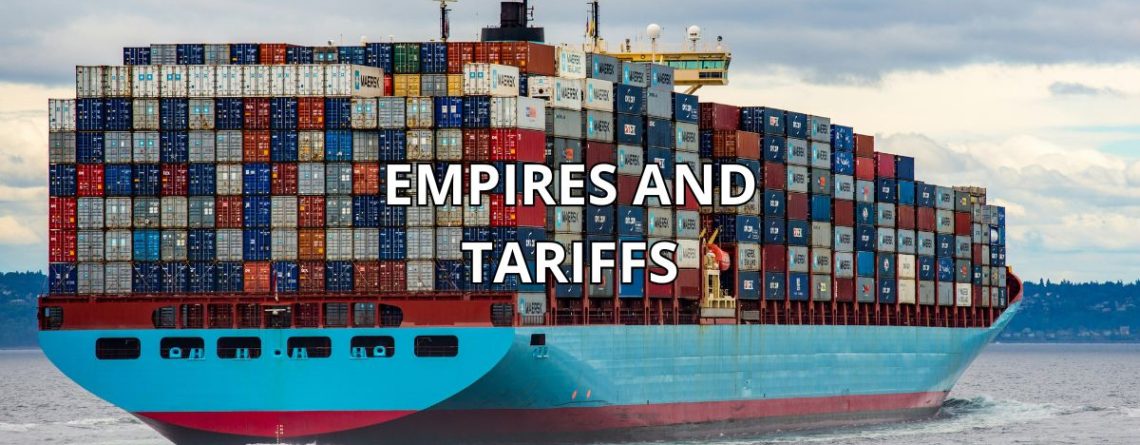
Tariffs
There has been quite a bit of microeconomic consternation generated by the Trump reciprocal tariff strategy.
To be quite honest, I have personally been somewhat perplexed as to the rationale behind the Trump Administration’s drive for this.
It should not come as a surprise to anyone. He has been talking about this for over a decade, but in the grand scheme of things I would have thought this was largely symbolic, offering very little direct benefit to the American people. More importantly, it risks, in the short-run, a severe detriment to our quality of life, especially vis a vis cheap consumer goods coming into America produced in China.
President Trump has argued, quite persuasively, that foreign countries simply don’t buy enough of our products. The underlying belief is that foreign tariffs on U.S. made goods make it impossible for U.S. manufactured goods to compete in foreign lands.
Fair enough.
But what if that is not really the case. What exactly are Chinese consumers in Beijing clamoring for that the U.S. produces? What automobiles produced in America are the Brazilians just dying to purchase?
Assuming a complete eradication of all transnational tariffs, exactly what products made in the U.S. would not end up being sold in foreign markets? Sure… commodities (ie: beef, petroleum, agriculture) might end up moving more freely, but exactly what value-added products will make their ways overseas?
In the final analysis, it simply costs more to produce a TV in the U.S. than it does in China. There are all sorts of reasons for this. The two most dramatic areas of cost are regulation and labor. A Chinese manufacturer simply does not have to incur those factors of production. More importantly, these factors of production in foreign lands are so bloody low that a manufacturer can create the product, package the product, and sell the product into the U.S. retail market for a price that is significantly lower than a similarly produced U.S. good that does not have the same shipping costs.
So, how is that going to change with reciprocal tariffs?
This has left me scratching my head. Yet, perhaps my failure of vision was a direct result of only looking at the microeconomic reality. Perhaps there is a macro reality that helps explain things better.
Let’s start with pain points.
From a Chinese perspective, there are two separate considerations to take into account. First, there is a tremendous amount of debt owed to China by the U.S. A trade war, or perhaps a more kinetic experience, puts a hold on those debt payments, which will affect Chinese liquidity. Second, there is the issue of system velocity. The Chinese produce a ton of “stuff”. That “stuff” needs to be produced, shipped, and paid for in a dramatic fashion with very, very low margins. If the system velocity is stymied, a catastrophic result can manifest within the entire Chinese financial structure. Human displacement in Asia becomes a real thing. In fact, a startling reduction in Chinese quality of life (or life itself) becomes a real thing. These are the types of things that typically spur on revolutionary movements.
Let’s then turn our attention to the U.S. The U.S. population has become massively dependent on two things. The first… access to margin. Our economic system is run on the purchase of items on credit. Imagine what would happen if our credit cards were suddenly to vanish. All of those big-screen TVs at Costco would start to pile up on the shelves if people had to actually pay the whole amount right then and there to purchase one. The second… and this goes back to that whole big-screen TV thing… is access to cheap goods.
Costco and Amazon have become powerhouses for a reason. The ability to access what are essentially luxury goods (we would now consider them to be staples) and low prices have driven the American consumer expectation.
Now imagine those are gone.
There is no widely available credit, and that $500 HD big-screen TV now costs $1500. Worse, the big box retailer where you used to buy that big-screen TV has now closed.
So, the question is: Which country can survive the pain long enough to ward off a revolutionary collapse, China or the U.S.? I honestly don’t know the answer to that question, but the Trump Administration is clearly betting on the U.S.
The other thing, and this is actually more interesting to me from a longterm perspective and dovetails with my “empire building” phase that I have written about before, is the idea of comparative advantages.
Countries tend to produce the things they are good at or, at a minimum, the things they can do cheaper than others. The United States made (in my opinion) a dangerous decision to stop being a producer of goods and, instead, become a producer of services. Other countries would go through the tedium of making stuff… we would offer services oriented towards dealing with the management of the stuff, or as is more often the case, dealing with the regulatory environment of the stuff.
Now we are seeing a competitor on the horizon and it is not a nation-state; it is a computer. We already know that AI is and will continue to be a disruptor to just about every service sector that exists… and we as a nation have put ourselves fully in the service sector column.
There are two things we are actually quite good at though: governance and tax collecting. This might become the American Empire’s long-run global contribution. Perhaps the Trump Administration is, in fact, looking to export American Imperialism, and as a corollary, American taxing authority to new and exotic locales to help support the empire.
Time will tell.






Comments (7)
For me, the problem with the previous trade situation was that the U.S. allowed itself to become completely dependent on an avowed enemy for truly essential goods, notably including medicines and military equipment. Given the likelihood of an eventual cold or hot war with China over such issues as Taiwan, we simply cannot continue to be entirely dependent on China for such things as the pills I have to take daily, or all the drones now used by armed forces.
However painful it is to regain the ability to make such essentials in the U.S. again, it will only become more painful to delay doing so.
Note: I’ve been a supporter of free trade for over fifty years, so this is a new view for me. Part of what I’ve recently realized is that calling something free trade does not make it free trade, particularly in situations where the free part only goes one way.
Coming from the automotive aftermarket segment of manufacturing, long term tariffs of this magnitude will be devastating to the industry. Points to consider:
1. The consumer does not care where it is made in this age, price point is key. If it works as intended and is the least expensive, the average customer will purchase the cheapest product that fits the bill, made in America be da****!
2. Working in a passion industry, if the price for either import or domestic products is too high, the customer will hold off; they don’t NEED the product, they want it! Especially when eggs are $8 a dozen! Consumer hesitation can and will kill a small business.
3. As you pointed out, our trade policy assumes the consumers in China are going to buy US products no matter what the price. From people I talk to, their buying habits tend to run on a more nationalistic line, especially since some products made in China are as good or better that US products. The parity is most likely never to going to happen.
4. Just to be clear to some who do not understand tariffs, we who import products to sell or use in products that we manufacture and sell, pay the tariffs directly, not China. Ultimately, the consumer does.
I hope someone flinches soon, or there will be a lot of pain to small businesses and the consumer.
The Law of Supply & Demand is simple, but Chaos Theory applies to the network of human interactions we call, “the economy”, since people are creative & have free will & property rights.
Hazlitt’s ’40s classic, “Economics in One Lesson”, expressed this before Chaos Theory was developed.
“Economic control” infringes Liberty & property rights, stifling the economy.
The American solution that comports with the Declaration of Independence is stated well by these two posts on X:
“Since, per Gödel, a perfect theory of a complex system doesn’t exist, & per Edward Lorenz & Poincaré,
attempts to control complex systems produce chaotic results, individuals’ pursuit of their rational
self-interest is the best Rx for optimal organization of complex societies”. – Hypatia @AlexandriaLibri
“We ought not to focus on controlling complex systems, but rather controlling ourselves so that macro-system behavior is likely livable.” – @normonics
WOW!! Love the post on Empires and Tariffs!!! Thank you for the always brilliant, fascinating and very educated insight!! The complexity of all the tariffs and economic changes and relations etc etc going on right now is so mind boggling (at least to me) but your post and explanation were sooo helpful and enlightening!
Thank you , Steven!
Perhaps the party is over and now we will have to get accustomed to paying more for goods. I understand the Trump’s reasoning behind the tariff actions but we shall see how all of this shakes out. Paola said that it always gets worse before it gets better. We are repositioning ourselves this year.
Hang on for the roller coaster ride!
All good and valid points, great article.
I’d like to add two points.
1. The overall cost of energy into the Chinese equation. They use a lot of coal and are still building coal plants. The resulting lower cost of energy to run the factories helps exporters with lower costs of production.
2. Their government offers rebates to the factories that export. These, often double-digit rebates, encourage factories to be aggressive on sales and competitive pricing to gain market share. It also helps absorb overhead to make domestic cost of goods lower.
Fair trade, be it through no tariffs on anyone or reciprocal tariffs on everyone, is balanced trade. Balanced trade eliminates financial distortions resulting from trade imbalances. I think we can agree that sending our production oversees has severely hurt our middle class and made our country dependent on other countries including those that don’t like us much. One of the most important competitive advantages for any country is an educated workforce. Add lots of land and natural resources plus better technology and we have a significant natural advantage. Sadly, most Americans can only afford to buy stuff from China by putting it on a credit card or financing that new car over three to four years. Meanwhile, we pay handsomely to keep the shipping lanes open while being blocked from foreign markets through tariffs and other barriers. If we can’t have free trade with other countries then let them protect their own ships from piracy.