

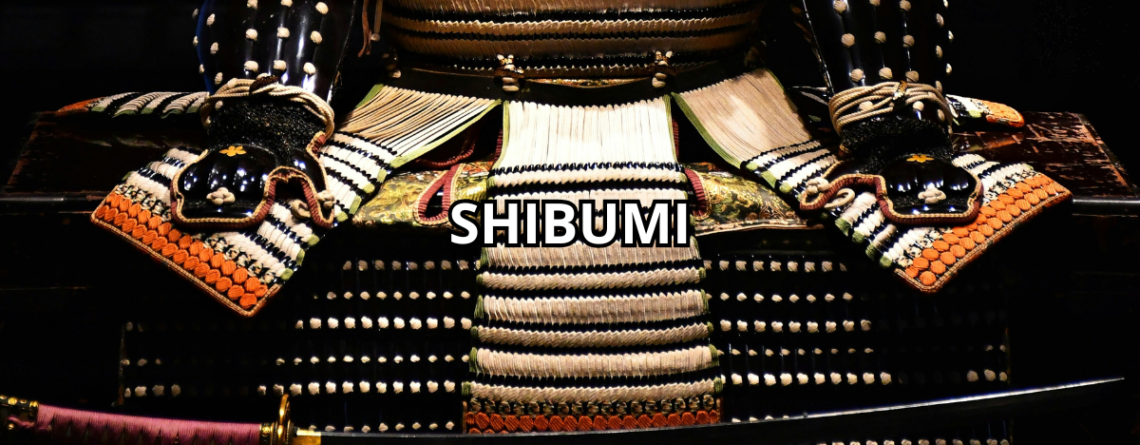
It is 1642 in feudal Japan.
You stand on a mountaintop gazing across the horizon at distant peaks. Before you on the windswept grass, there is a large wooden cross. It is roughly six feet tall. It is actually not a religious symbol; it is a martial arts training tool. It represents a man, the cross beams representing the enemy’s outstretched arms.
Next to the cross stands a samurai warrior.
He is absolutely magnificent to behold. He is in full regalia, black armor and helmet, with red flourishes along his arm and waist. You watch as he silently, purposefully draws his two swords from the sheaths. You instantly notice they are not steel swords. They are made of wood, training swords equally crafted to mimic the weight and feel of his actual blades.
Suddenly he begins to move about the cross striking it with his swords. Each strike is precisely executed. The wooden swords have become an extension of his body. He is an absolute master of skill-at-arms, and he embodies the ideal of shibumi… effortless perfection.
Now imagine our samurai warrior has been replaced by a modern 14-year-old boy. He is standing there with a tube of cardboard from his mom’s wrapping paper dispenser. When the whistle blows he just starts whacking away at the cross with the cardboard tube.
These are the two extreme ends of our spectrum of mastery at skill-at-arms.
It also illustrates our pathway towards unconscious competency.
Many of you are familiar with the concept. It was taught in various MBA programs in the early aughts when that sort of thing was in vogue.
Essentially, the argument is people exist in one of four states when it comes to physical competency. (Theoretically this would extend to intellectual competency as well, but it was first illustrated with athletic endeavors.)
The first level is unconscious incompetency. The students simply do not know how badly they suck.
We see people like this all the time. They have owned guns for years. They have a rudimentary understanding of how a gun works, and they may even have a fairly deep level of understanding of metallurgy and chemical reactions. They have seen the movies, they have played the video games, and they may have even been to the range several times. What could they possibly learn from an instructor when it comes to skill-at-arms?
These people are unconsciously incompetent; they simply don’t know what they don’t know.
Then they come into a class.
At the end of the class, they have had an elevation in thinking, an epiphany of status. They are now fundamentally aware they don’t know what they thought they had known. They now realize they suck. They have grown in a sense… they are now consciously incompetent.
For some, this level of self-awareness is simply too much. Their egos are too fragile. Others, however, will grow from this experience and become dedicated to the prospect of repetitive training with purpose. They will take more classes; they will practice drills. They will do it again and again and again. Within a surprisingly short amount of time, they will elevate again… they will become consciously competent. They can do it… but they have to think about it.
Think about when you received your driver’s license. You were probably young, and most likely chomping at the bit to drive by yourself, but terrified at the same time.
I remember on my 16th birthday, my mother told me I needed to drive to the store to pick up some groceries for her. It was my first mission! I was thrilled… and absolutely frozen with fear simultaneously.
I did it though. I navigated our family car through the hellscape that is the roads of Anaheim Hills. I was hyperaware of every action I engaged in, from putting on my seatbelt, to hitting my blinkers.
I did it… but I was laser focused the entire time.
Now we come to today.
I am driving using my knee to control the steering wheel. With both hands I open the top to a Monster energy drink, while talking on the phone to Sandy.
I have absolutely no doubt I will arrive at my destination without issue. It simply never occurs to me that I could do anything dangerous.
I have achieved unconscious competency… shibumi to our Japanese samurai.
This is the place we need to arrive when it comes to our weapons.
We have long ago relegated the samurai sword, the saber, or the foil to works of art on walls and mantels. Now we carry firearms as the functional equivalent of those medieval tools of self-defense. Yet, while the tools have changed, the mental requirements have not. We must dedicate ourselves to the achievement of mastery at skill-at-arms… we must become unconsciously competent.







Comments (3)
This is so spot on! Thank you for bringing this point to our attention!
Appreciate the professionalism and the world class training your facility bring.
“He who knows not, and knows not he knows not, is a fool. Avoid him.
He who knows not, and knows he knows not, is a student. Teach him.
He who knows, and knows not he knows, is asleep. Wake him.
He who knows, and knows he knows, is wise. Follow him.”
– Arabian