

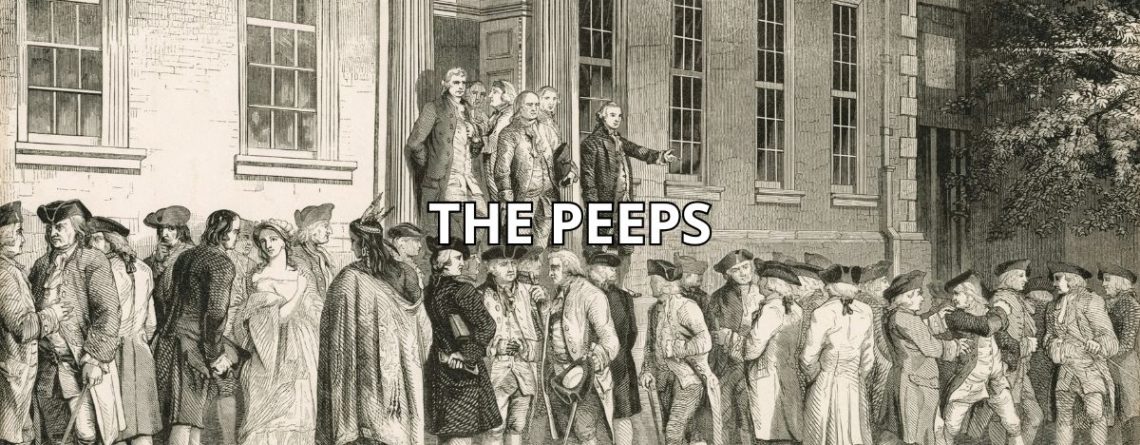
“We the People”
“Let my People Go!”
“Power to the People”
“Vox Populi Baby!”
…And the one who speaks to us in our community: The right of the people to keep and bear arms shall not be infringed.
But who are “The People”? Or, perhaps, it would be more grammatically correct to say, “What IS the People”? After all, the way we discuss the “The People” and specifically how the courts have interpreted the meaning of “The People” would suggest that this is some form of a collective that can be looked at as an individual unit.
This is, in and of itself, consistent with our empirical view of the “other”. The enemies at the gates are not individuals with unique ambitions. They are a singular entity seeking to destroy humanity.
We then can view ourselves as a singular entity… and if you are the State, then you view your subjects as, well, an existential threat to… you.
This is historically consistent. Very few polities die of natural causes. The aristocracy is usually subjected to a brutal dethronement either by the barbarians at the gates of the country or citizens at the gates of the palace. International intrigue can help with the former, blaming the “others” can help with the latter, but only for so long. Eventually the rubber really does meet the road, but usually the meat grinder comes out first.
So, are The People those who threaten the State with its very existence? Are The People the individual economic units that power the mechanism of the State through taxation? Are The People the circular economy creating the organism of commerce that, again… provides an avenue for taxation?
Or, as the Framers put it… are “The People” the seat of political power?
The People are created with the full panoply of individual liberty, but relinquish certain portions of the power to the State to have it regulated on their behalf. But when the State even attempts to expand its power at the expense of The People, the power automatically reverts back to The People so they can formulate a new government to then offer up their limited request for regulation. The old government, in a sense, becomes illegitimate.
It’s a nice theory indeed. But how exactly does that work? A despotic government that has intruded into its citizen’s individual liberties does not simply go quietly into that good night. It has to be forcibly shown the door. What happens when the government becomes the interloper refusing to head home at the appointed hour?
That is the traditionalist argument of the Second Amendment. It is the teeth behind the request. No… it is not the overweight suburban slob standing on his porch with a shotgun screaming about the government. (Though, truth be told, there is a certain romantic fatalistic beauty in that image.) Rather, it is the recognition on the part of the government itself that when it has been replaced, it should heed departure since there are more subjects than soldiers, more patriots than pretorians. The Second Amendment must apply to The People as a whole, because it is The People who are ultimately the final arbiter of power. It is The People who have retained the power to govern from the beginning. It is the government that has been granted limited powers by The People to create the functioning system to allow for commerce, safety, and predictability of social intercourse.
That is literally it.
When The People have had enough… and they always do… it is the ability of The People to take back their regulatory powers and grant them to someone or something else to have it structured differently and to afford them the ability to achieve transcendent grace. This is who The People are… and The People must have the ability to defend themselves.




Comments (2)
This is why even the most fervent supporters of a party that gained and keeps power via ballot fraud should oppose such fraud. Once all parties realize differences can no longer be resolved by voting, they are inevitably resolved by force, as in most societies around the world throughout history.
“A man’s freedom rests on three boxes. The ballot box, the jury box, and the cartridge box.” — Frederick Douglass.
I wish this subject would be taught with this fervor in public schools! I think people would grow up feeling empowered instead of like “Subjects”.