

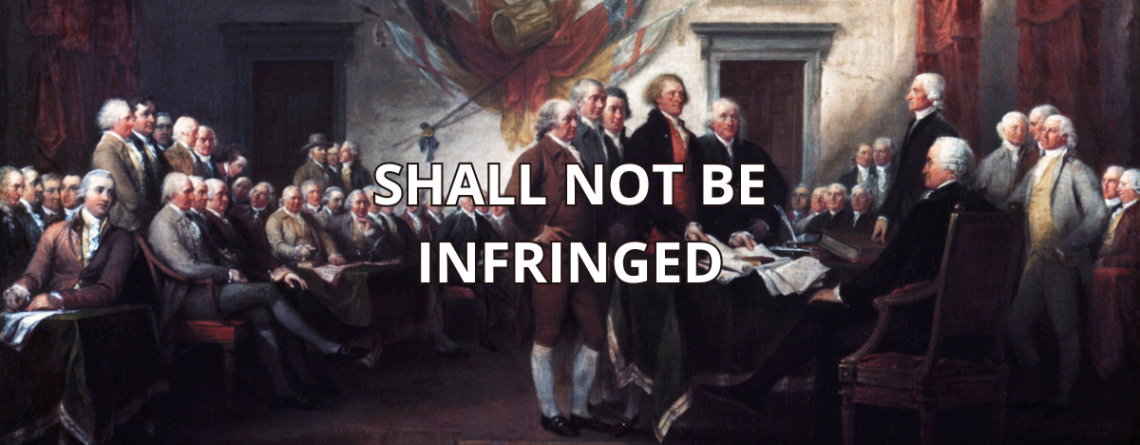
“…Shall not be infringed.”
Those are interesting, and not often quoted words. While my readers instantly recognize them from the end of the Second Amendment to the United States Constitution, they are rarely quoted (save the occasional meme of course).
Their absence in jurisprudence is troubling, but somewhat understandable. To ultimately rely on this doctrine, when taken to its logical conclusion, would render the power of the State over the individual virtually nonexistent.
The phrase, “shall not be infringed” only appears once in the Constitution. The other amendments in the Bill of Rights restrict what the government can do. The First begins with the admonition that “Congress shall make no law”. While the other rights speak with specificity of what a person is entitled to vis a vis government conduct (or misconduct).
My law partner, the inimitable LTC Cosmo Taormina has suggested the ultimate “right to privacy” does not exist in the “penumbras of the Constitution” as articulated by Justice Douglas in Griswold v Connecticut. Rather, it is most apparent in the glorious Third Amendment to the Constitution, where the Framers stated, in no uncertain terms, “No Soldier shall, in time of peace be quartered in any house, without the consent of the Owner, nor in time of war, but in a manner to be prescribed by law.” At the time of our nation’s founding we did not have police, we were subject to military rule, specifically British military rule. When a solider is quartered in your home, you have an agent of the State under your roof, in other words… a complete lack of privacy.
So, in the First we get a direct admonishment. In the Third through the Tenth we get a laundry list. But in the Second we get something entirely different… “shall not be infringed.”
The parsing of words is done on purpose. The Framers also drafted the Bill of Rights in anything but a cavalier manner. They were all too aware that future generations of lawyers would be engaging in wide ranging debates about the scope of Constitutional rights. So it is all too necessary and proper that we look to what they were trying to encapsulate in this amendment. After all… they could have easily stated, “The people will retain the right to keep and bear arms.” That would have been neat and tidy. It also would have comported to the linguistic dialect of the Framers. They purposely did not use those words. Instead, they said something different… something far more expansive… and far more detrimental to the government interest.
Keep in mind the Framers were deathly afraid of expansive government. They did not see government as a means to some form of temporal salvation; they saw government as an empowering instrument for tyrants. They sought to create a system that kept the tyrant at bay, or at the very least, rob him of his power to inflict misery on future generations. More specifically, they sought to construct a system of government that allowed the people to retain the ultimate authority over the government itself. Elections are not enough to enshrine freedom. Sometimes the threat of an usurpation is needed to keep the government in line.
The State, like any institution, seeks growth and legitimacy. Unfortunately, the growth of the State is, by definition, an abrogation of individual liberty. The Framers knew there would be an inevitable push for greater governmental control, and, by extension, further and further relinquishments of individual freedom. To ensure that certain abrogations of freedom would never occur, they codified the preexisting rights found in the Bill of Rights. Essentially, they took certain governmental intrusions on our most sacred (and recognizable) rights, and expressively prohibited governmental interference.
“Congress shall make no law…”
That is pretty clear cut.
But what do we make of “…shall not be infringed”?
That is a far more expansive admonition.
Justice Scalia in the landmark opinion Heller v DC articulated the Second Amendment protects arms that are in “common use”. He further articulated […] the Second Amendment protects arms that are in common use for lawful purposes, such as self defense.
The State has argued that what he said, he did not mean. After all, if a weapon is being used for the lawful purpose of target shooting, or hunting, or competition, or art… it is being used for a lawful purpose. The State has altered the phrase in subsequent pleadings (assault weapon challenges primarily) to instead read, “The Second Amendment protects arms that are in common use for the lawful purpose of self defense.”
This is a miscarriage of the dictate.
It has also placed us in an entirely defensive position. We spend our time arguing to get back to zero. Each inch of ground we acquire simply takes us back to what we already had. It is time the State take on the defensive posture.
The Framers gave us this tool in the most interesting turn of phrases, ”…shall not be infringed.”
Any “infringement” on our right to keep and bear arms is, by definition, a State action that is extra-Constitutional. A law that says you cannot speak certain utterances is instantly apparent as a First Amendment violation… but what about a zoning restriction prohibiting certain commercial conduct?
If someone wants to sell or service arms in a particular location, and the State is prohibiting that form of commercial activity, then the right to acquire arms (a necessary predicate component to the right to keep and bear arms) has been infringed upon. That restriction is, by extension, unconstitutional.
What about the State seeking to marginalize gun ownership through negative admonitions regarding guns and gun ownership? It creates a potential chilling effect, and, by definition, acts as an infringement.
Demanding certifications, mandated storage laws, ammunition restrictions, waiting periods, the whole litany of legislation that seeks to restrict, or at the very least make difficult, the acquisition and keeping of arms… an infringement at the very least… a full abrogation at the worst.





Comments (2)
Everything you said, Steven, is right on the mark. However, because of how the 2nd is worded, and therefore, unfortunately, in our modern world, the 2nd is the most misunderstood, misread, misinterpreted and/or re-interpreted amendment. Even with the recent and past decisions by the Supremes, democrat legislatures around the country continue to infringe and will continue to infringe no matter what the Court says. Hawaii being the prime example with total disregard for the Court followed by California and New York. The only remedy is for gun groups to continue the pushback with lawsuits and voting for pro 2nd candidates. I am not sure the battle is even winnable in today’s political and social environments. But, I, for one, will stay in the fight.
“Sometimes the threat of an usurpation is needed to keep the government in line.”