

The LTC was sitting in his usual chair in front of the fireplace, a cigar in one hand, a crystal glass in the other, and a sly smile on his face as he studied the portrait of Napoleon hanging above the mantel.
As I approached he must have sensed my presence and without looking at me he casually waved towards the leather chair next to him.
On the small table, between the two chairs, a glass of Lagavulin and an unlit cigar waited patiently for me.
“I see you have made preparations for my arrival, Colonel.”
“Yes, Captain, all good things come as a direct result of preparation.”
“Parare successu.”
“Préparer le succès, mon capitan.”
I sat down and settled in. After lighting my cigar, I leaned back and raised my glass towards him in a toast.
“Audace!”
“Audace, mon capitan.”
There was a momentary pause as we both took sips from our glasses and studied the fire.
“History tonight, Captain?”
“As always, Colonel.”
He smiled and began. “Have you ever wondered about ‘why Europe’ when it came to exploration and empire?”
“As opposed to?”
“China.”
“What are your thoughts, Colonel?”
“We tend to think of the European expansion to the Americas beginning in 1492, notwithstanding Leif Erikson, of course, but that does sort of miss the point, does it not?”
I raised an eyebrow.
“Europe had been involved pretty heavily in trade in the decades preceding Columbus’ little excursion to Hispaniola. He had relied pretty heavily on the writings of Marco Polo. More importantly, the Chinese had a rich, and arguably more advanced, naval presence. Why then did they not ‘discover’ America?”
“Trade was not as important to them?”
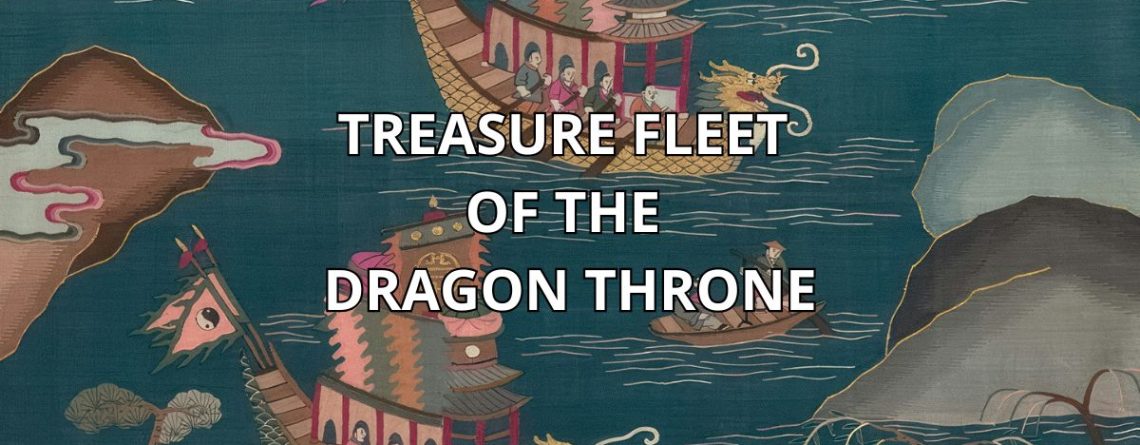
“Perhaps. Have you ever heard of the Treasure Fleet of the Dragon Throne?”
“Was that not somewhat of a Chinese coast guard?”
“Oh, Captain, more aggressive than that I am afraid. While Christopher Columbus was sailing across the Atlantic with a mighty fleet of three ships, the Treasure Fleet roughly 90 years earlier was plying the South Pacific with over 250 ships, most of them men of war.”
“Impressive.”
“Yes, but their mission was different, and therein lies the lesson.”
I took another drink of my whisky. “Do tell, Colonel.”
“The Treasure Fleet of the Dragon Throne was really a show of force against political rivals, not a use of military dominance to secure trade routes. More importantly, there was a certain cultural bias that doomed the Chinese to provincialism. They were well versed in the goods and, to a lesser extent, the services that could be acquired from the foreign lands of Europe, but they saw themselves as intellectually and culturally superior to the barbarians to the west. Why invest time and treasure to seek out enlightenment from those who are certainly not as enlightened?”
“Valid point,” I said, now taking a puff from my cigar.
“Then there was the issue of competition. The Chinese Empire just simply did not have any. In Europe there was the constant jockeying of position between the kingdoms of Spain, Portugal, the Dutch, and, of course, the Holy Roman Empire. Prestige… and real estate meant prestige… was just as important as wealth. Spain had to counter Dutch dominance in the Far East if Spain would continue to have relevance in Europe itself.”
“Iron sharpens iron.”
“Yes, Captain. Iron does sharpen iron, but tempered with the humility a blade can always be sharper in the first place, or made better, or of a stronger design. Competition drives us to glory, but so does the humility that comes with knowing what lies beyond the horizon may just possibly yield knowledge that transcends our own.”
“Semper humilem!” I said, raising my glass again to the LTC.
“Semper humilem,” he said toasting me in return; then softly he said, “Ad glorium.”







Comment (1)
A woman who grew up in China told me that the reason European nations are small and China is big is because European men are brave, while Chinese men are cowards. European men were brave enough to defend their local territory.