


The LTC slowly poured the whisky into his glass, his lit cigar held in the same hand that clutched the bottle as the smoke gently rose above him. The light from the fireplace flickered across the room and there was a certain level of precariousness that seemed to add a level of complexity to the operation. I studied him as he placed the stopper back into the bottle and placed it on the table between us. He leaned back into the leather chair and relaxed. His mission had been accomplished without any spillage of liquor.
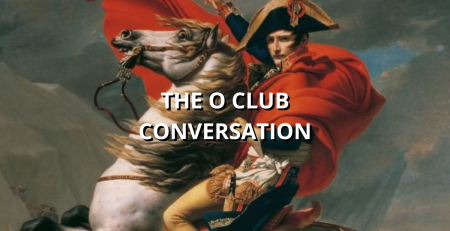
He grabbed for his glass and raised it in a mock toast to the picture of Napoleon on horseback that hung over the fireplace, then took a sip from the crystal glass.
“Tout tres bien, mon Colonel?”
“Oui, mon Capitan,” he said, placing the glass down on the end table.
After he had placed it on the wood surface, he paused and looked at it for a second then reached back over and moved it onto a coaster.
“I don’t want your Delany coming around and chastising me.”
I chuckled. “I am fairly sure that her dominion extends only to the bar at Habanas.”
“I disagree, Captain; her ability to civilize goes beyond the four corners of her temporal environment.”
“Are you referring just to her, or to the ideal of feminine control as a civilizing force?”
The LTC raised an eyebrow.
“Captain, are you trying to lead me down the path to sexism?”
“Embrace your inner troglodyte, Colonel.”
“Ah, Captain, I’ll take the bait, though I think the ‘querelle des femmes’ has been grotesquely over-exaggerated throughout the centuries.”
“My turn to take the bait, Colonel. Are you suggesting that sexism has not, in fact, been a driving force? I think there is ample empirical evidence to suggest it has.”
“Oh it has, Captain, but that has largely been a result of a foundational misunderstanding of the nature of commerce. Women have historically had significantly more power than historians were willing to admit.”
“The Lysistrata type power?”
The LTC now had his chance to chuckle.
“No. Aristophanes aside, women have had a commercial effect that far transcends sexual access to men. In fact, had more historians been trained in the dark arts of economics, the way we have written about history and, by extension, women, would have been completely different.”
“Colonel, are you channeling your inner Marxist?”
“Ha, no Captain! You know my capitalist credentials remain completely unblemished. That said, I do wish more historians had a higher degree of economic literacy, including Marx for that matter.”
“Okay, Colonel. What are you driving at?”
“Captain, the history of societies has largely been oriented around the development and fabrication of natural resources into something usable by an individual. Nations have gone to war against one another for access to “stuff” or oftentimes access to the pathways to move “stuff” from one place to another. Then there is the building and refining of “stuff”. The captains of industry are just that, those that have had the charisma, or luck, to engage a vast amount of people in the industry of discovering or improving access to ‘stuff’.”
“Okay, Colonel, we are in agreement, but I fail to see your point.”
“Stay with me, Captain, most “stuff” and the methods to produce “stuff” have been the result of engineering marvels and, to a certain degree, physical prowess. But all of this, quite literally the entirety of the operation, has been exclusively predicated on only one side of the equation. To be more clear, the study of history is, to a large extent, the study of supply of goods.”
“Interesting, Colonel; I’ve never really considered that before.”
“But imagine, my dear Captain, the tremendous amount of time, treasure, and toil that was spent on the development of an industry if only to find there was no one to buy the final product, or worse, the final product was rejected by the marketplace. Would Florence have had the De Medicis had it not been originally for dyed garments? Would Venice have not become an international trading magnate had there not been a reason for international trade? Would we have had robber barons if there was no need for a railroad? All these things are fascinating to read about, inspiring to imagine, but only are half of the equation.”
“Half the equation?”
“Yes, Captain, the supply might be robust, but without demand it means nothing.”
“And women create the demand?”
“Historically, yes. Who bought the fabric? Who decorated the villas? Who decided what hors d’oeuvres would be served? The list goes on indefinitely. Without women there would have been no market, and without a market there would have been no need for a supply. Women, my dear Captain, have had a far greater position of power than historians have given them credit for.”
I held up my crystal glass towards the LTC, “To the market, Colonel!”
He smiled, “Indeed, Captain… to the market.”




Comments (4)
Women’s participation in the market place is easily measured, just check the labels on the packages that arrive on our doorsteps and see who they are addressed to.
I agree! What’s that saying…”Behind every success man is a woman”
We cannot under estimate the power of women. Without women we are only a fabric that has yet to be woven together.
If I might diverge for a moment to bring up current events in this context: When is a man a women? I am aware of a school board member who was elected into position as a man, then only to petition to have a women’s name (and not sure what other [physical] changes were made in the interim). Is this robbing from women? Is this unethical (name change after the fact)? Should this person resign? I have a lot of questions.
I am pro women, and believe that women’s sports are for women, and women only. Now I must decide if a man can be a true representative of people when that individual decides that the man thing is the wrong path, even after a mature life! Is he/she doing a disservice to those who are being represented? Again, I have a lot of questions.
I did not mean to hijack your excellent commentary, but this is a very recent and real topic. This is part of our current issues in society. To me it is fringe, and I’d prefer to stay with the status quo of history here: a man is a man, and a woman is a woman. I do apologize if I am abruptly inappropriate, but there are certain norms that are challenged and I am not ready to alter my point of view. Perhaps I need further education.
Your writing seemed like a segue into the woman / man issues of the day.
The Law of Supply & Demand is simple, but Chaos Theory applies to the network of human interactions we call, “the economy”, since people are creative, have free will, & property rights.
Hazlitt’s 1940s classic, “Economics in One Lesson”, expressed this before Chaos Theory existed.
“Economic control” infringes Liberty & property rights, stifling the economy.
“Since, per Gödel, a perfect theory of a complex system doesn’t exist, & per Edward Lorenz & Poincaré,
attempts to control complex systems produce chaotic results, individuals’ pursuit of their rational
self-interest is the best Rx for optimal organization of complex societies”. – Hypatia@AlexandriaLibri
Women certainly make their contribution to the chaos. 😉